For card issuers and loyalty programs
Give the Flight Delay Pass free: as a benefit built into your card, or paid with the points and miles members already hold. The Underwriter offers the pass and funds every rescue card. GetThere runs it.
| Date | Flight | Route | Time | Status |
|---|---|---|---|---|
| FRI 20 NOV | Original | SYD → SIN | 09:55 | DELAYED 13:45 |
| FRI 20 NOV | Rebooked | SYD → SIN | 10:50 | BOARDING |
| SAT 28 NOV | Rebooked | SIN → SYD | 20:40 | BOOKED |
Two ways to give it
Either way you buy the pass at cost: 60% of the pass fee, $22.50 on a $37.50 pass. That covers the rescue card money, card costs and GetThere's platform fee, with no profit pool on top. You pay monthly, only for passes issued.
Every trip paid on your premium card gets a free pass, a few a year, or a welcome offer. It sits beside your travel insurance as a benefit they use on the day.
Example: 50,000 premium cardholders taking 2 passes a year costs about $2.25M, or $45 a card.
Members swap points or miles on your redemption page for a voucher worth the whole pass, and pay nothing at checkout. You set the price. An everyday way to spend between big redemptions.
Example: 3,000 points for a pass that costs you $22.50 is 0.75 cents a point.
Members who'd rather pay earn your points or miles on the fee, from your share. A $41.25 pass brings a $750 rescue card when a same-day seat costs hundreds in cash.
Example: 4 points a dollar on a $37.50 pass is 150 points, from a share of about $7.50.
Sales tax is added for where the member lives, and the rescue card is the same however the pass is paid.
The journey
Your app sends one nudge after an airline charge. The member redeems a voucher, forwards the booking email, and checks out with the Underwriter. GetThere runs every step after the nudge.
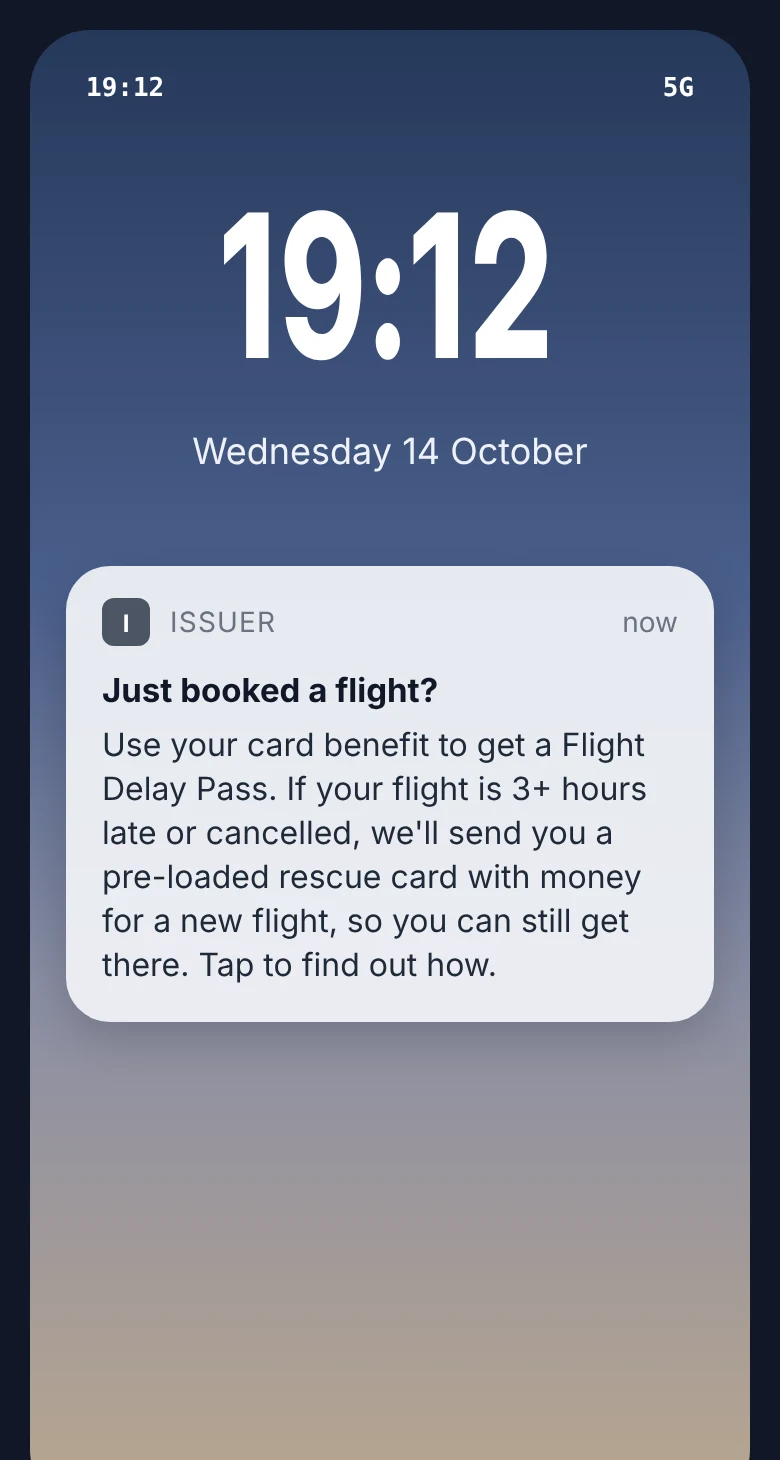
An airline charge on your card, a click-through to an airline, or miles moved to an airline program. Your app asks "Just booked a flight?" and invites them to use their benefit. You choose which cards, members and charges get it.
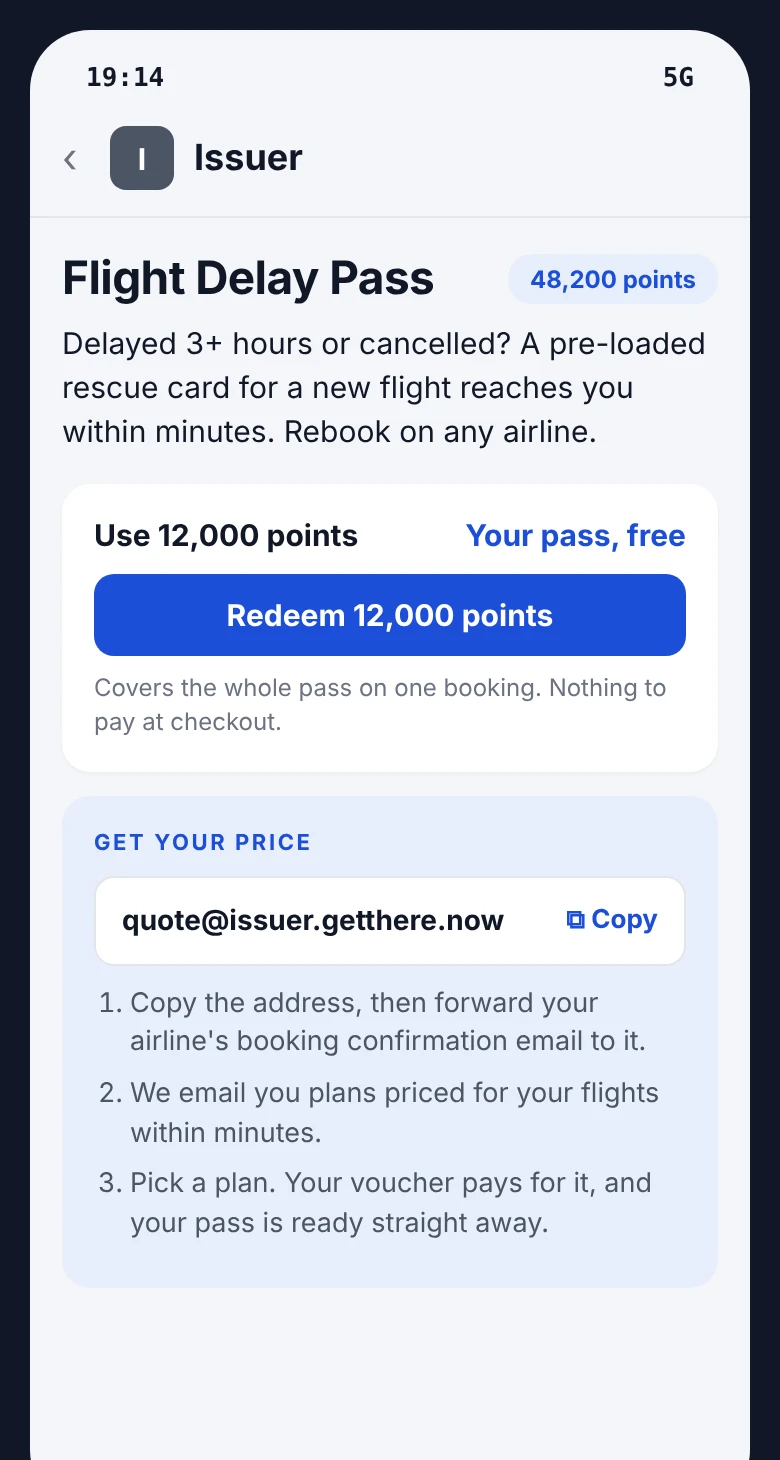
Your pass page, beside your other redemption partners, offers the pass free for 12,000 points, or as the card benefit. One tap puts a voucher for the whole pass on her account.
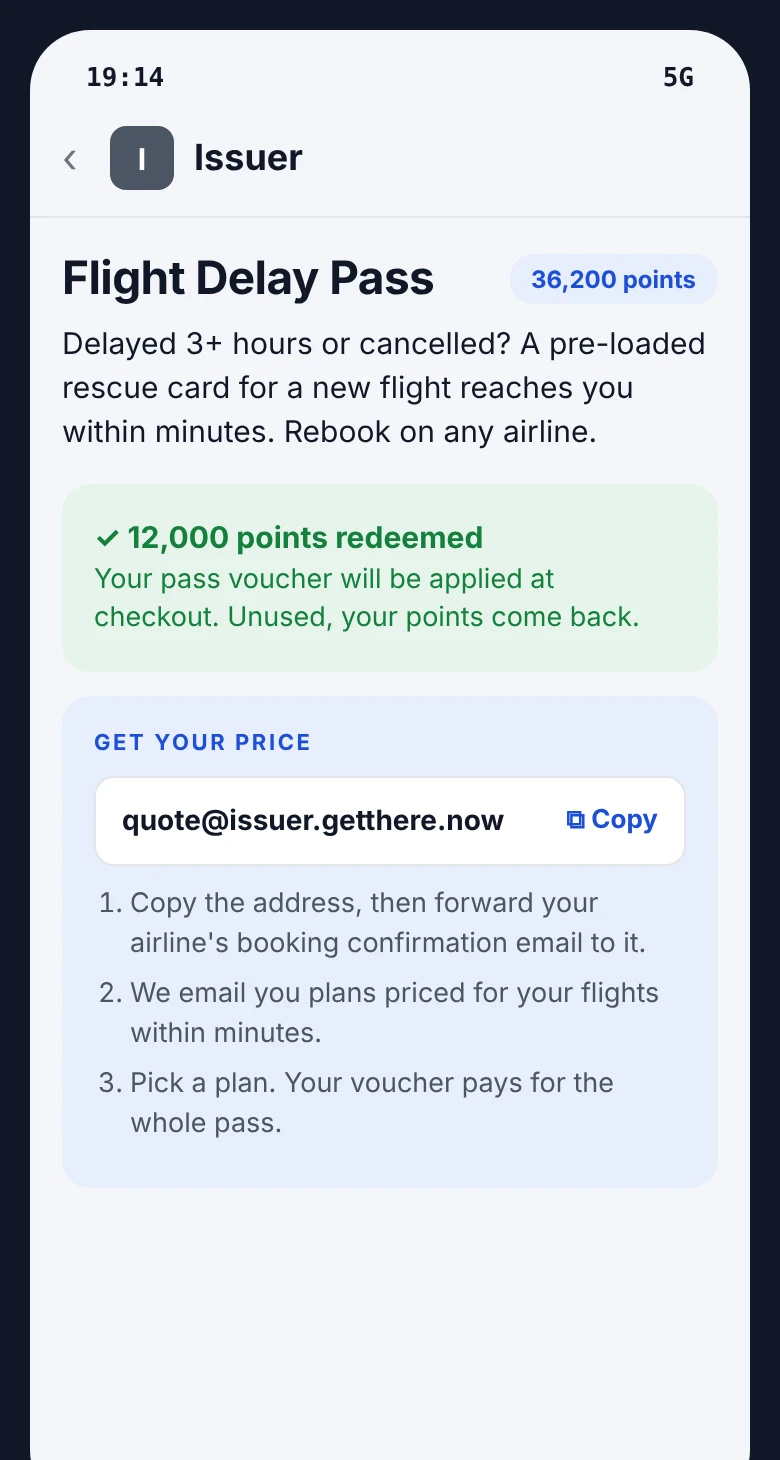
The page shows her own forwarding address. She forwards the airline's booking email to it: no form, no flight numbers to type, and no booking data leaves you.
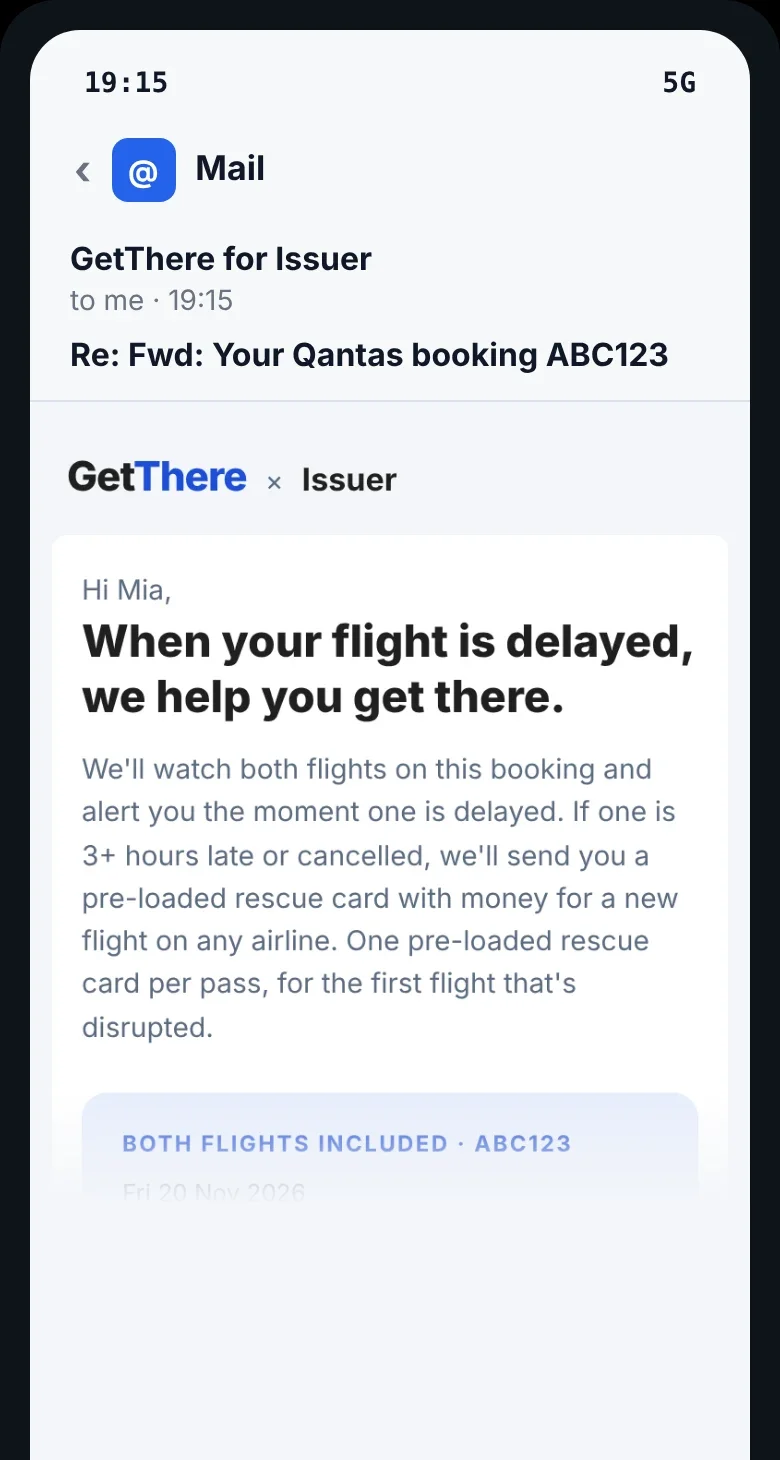
A price for every flight and traveller on the booking, in the Underwriter's brand, sold through you.
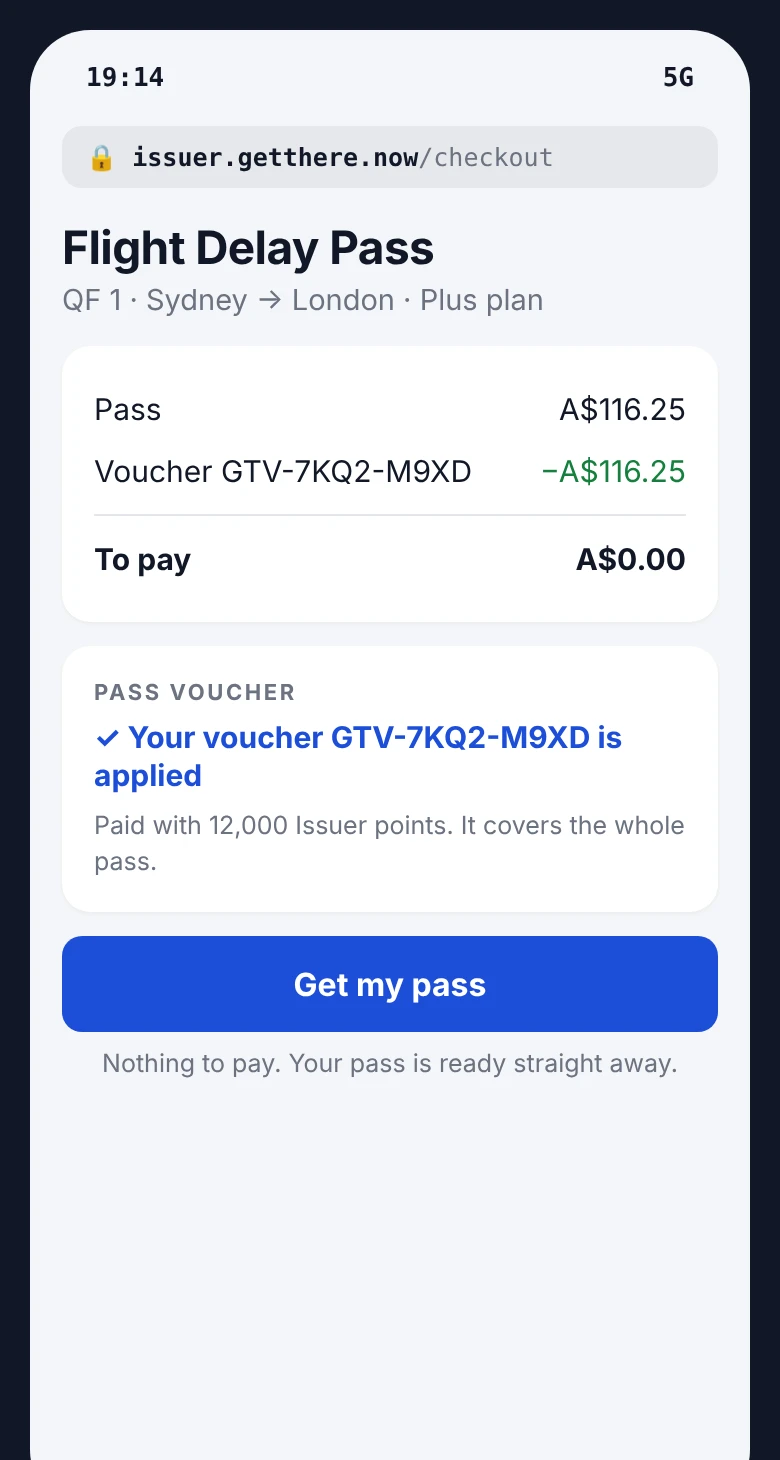
The Underwriter's checkout, sold through you, opens with her voucher covering the whole pass. She agrees to the Underwriter's terms and pays nothing.
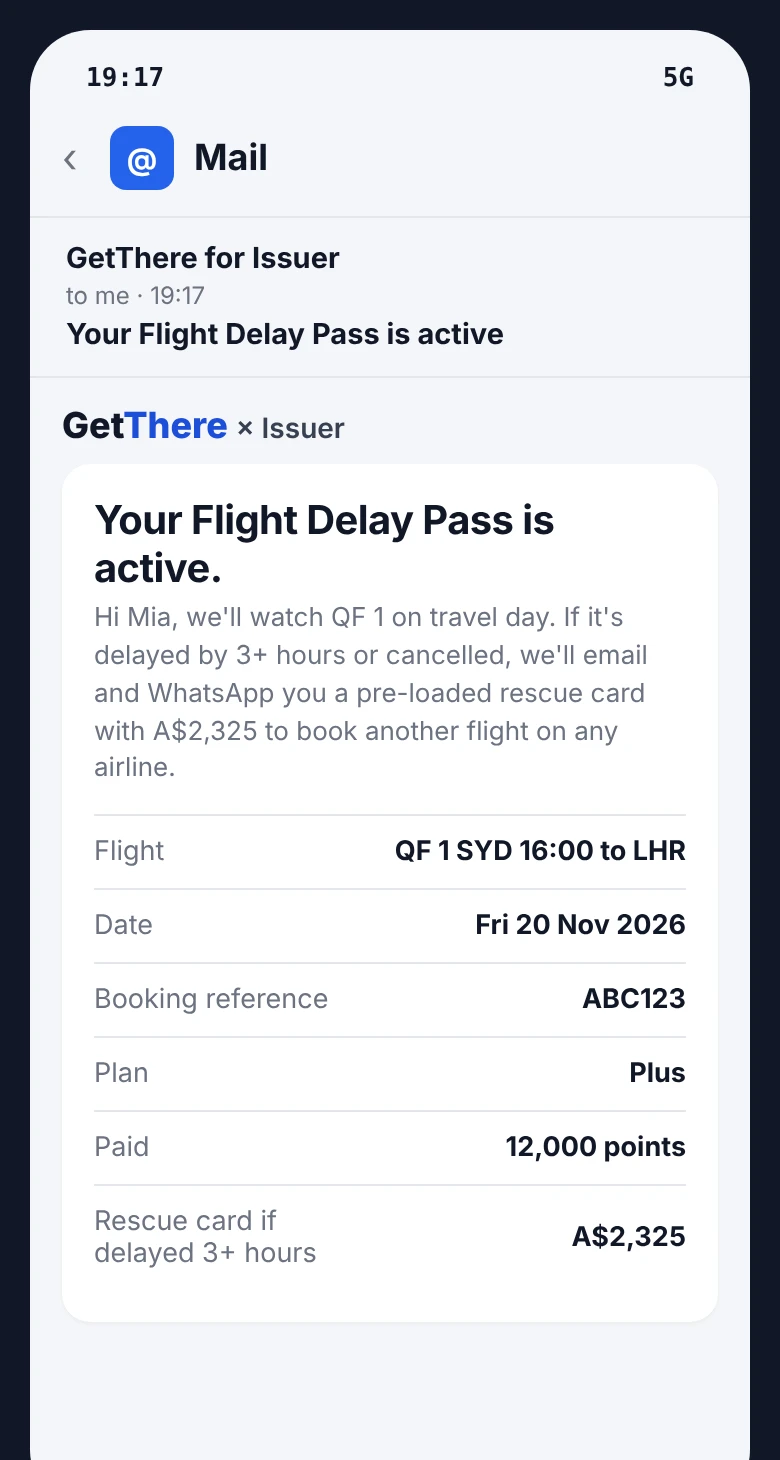
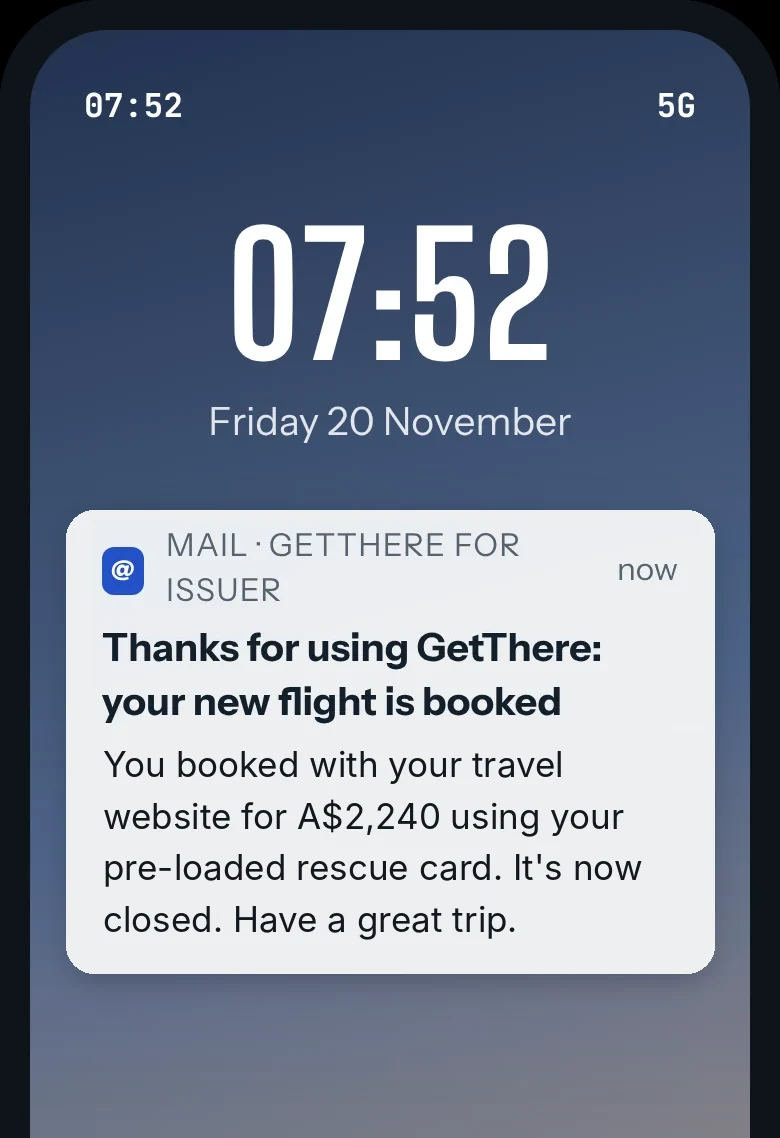
Issued straight away. The email lists the flights covered, the points she paid, and the rescue card she gets if a flight is delayed 3+ hours or cancelled.
When to send the nudge
Send "Just booked a flight?" at whichever of these you see: one call to GetThere with your member id and what you know about the booking, then your push.
Near real time. You send the charge with the offer, and GetThere checks the booking forwarded on it matches.
The member leaves your app to book and earn, or a linked card is charged at an airline or travel site. A travel site charge may be a hotel: a forwarded hotel email just gets a polite reply.
A transfer to KrisFlyer, Asia Miles or Avios usually means an award booking is coming. Ask "Booked your award flight?" a day later.
Award bookings
On award bookings the cash paid is usually just taxes. So GetThere values the flights at miles used × value per mile, plus the cash paid, capped at today's cash price for the seats, and sizes the rescue card from that.
A member stranded on an award flight pays cash for a new seat, so the rescue card matters more, not less.
Example figures. GetThere sets the value per mile for each program, capped at the seats' cash price.
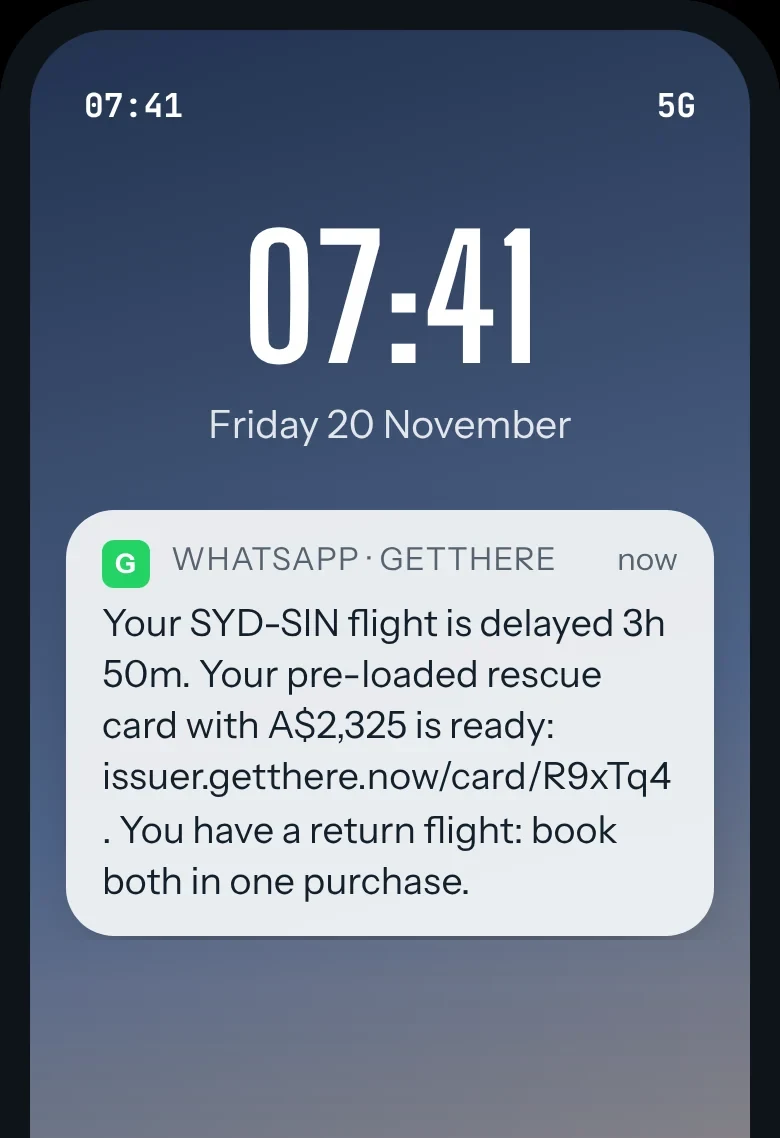
Friday, at the airport
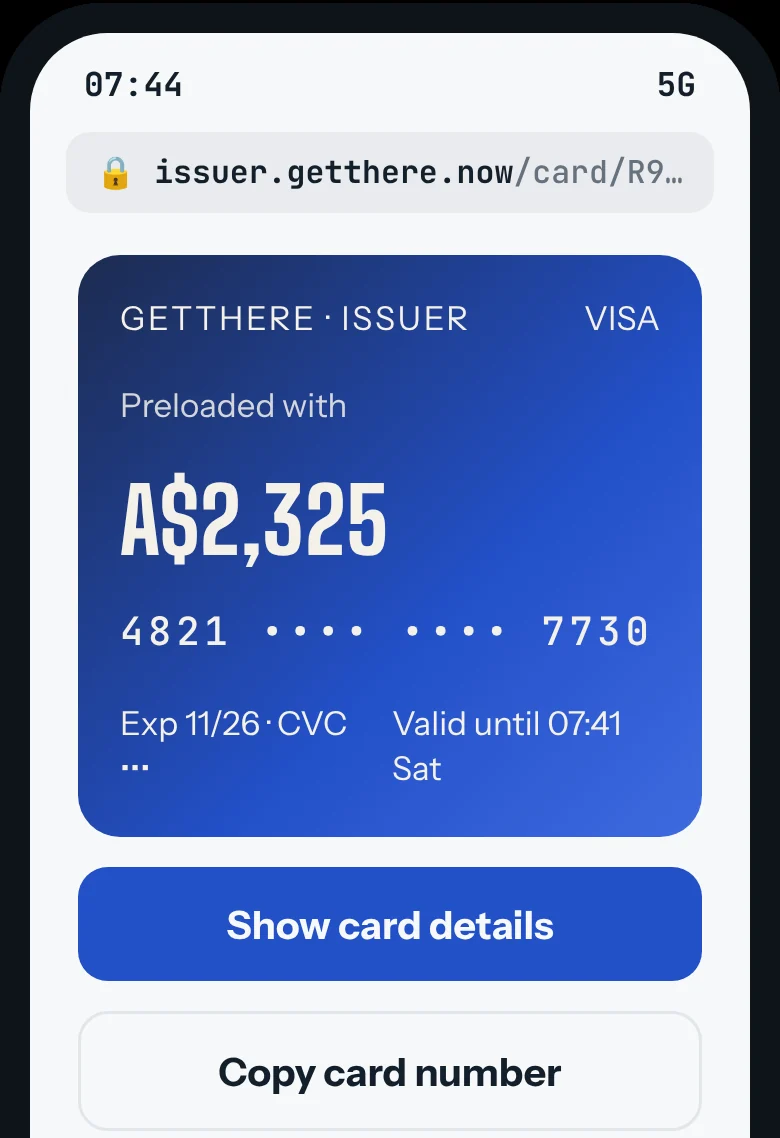
Not the airline's next free seat, and not a refund weeks later. Live flight data triggers the rescue card, with no claim to make.


Your partner dashboard
Sign in at partners.getthere.now to see your own members only: offers opened, bookings forwarded, passes issued, vouchers redeemed, what you owe for benefit passes and your share on paid ones.
| Nudge sent after | Offers | Forwarded | Passes |
|---|---|---|---|
| Airline charge on card | 51,300 | 5,640 | 1,180 |
| Click-through to book | 24,900 | 2,010 | 370 |
| Miles moved to an airline | 5,800 | 550 | 90 |
Example figures, not forecasts. You and the Underwriter also get a monthly report, with six months of trends and member feedback.
Already a partner? Sign in to your partner dashboard.
The business case
A card benefit or paid in points, at cost: $22.50 on a $37.50 pass. How it works.
Only your cardholders can get the pass, so travel spend moves to your card.
Something useful when they book, and the answer when a flight runs late.
An everyday redemption at a fixed price, between big award flights.
Half the profit on every pass a member pays for, paid once its trip is over.
Members who book with miles get a price too, based on what their miles are worth. Award bookings.
The numbers · an example
of pass fees a year before tax on $2B of airfare ($375K per $100M)
passes a year: 5 in 100 of 4 million bookings
what a free pass costs you, on a $37.50 fee. On paid passes your share is half the final profit pool
Priced for a 60% gross margin: rescue card money is 40% of the fee. The Underwriter receives the whole fee and pays everything below.
Example figures, not forecasts: $2B a year of airfare, 5 in 100 bookings get a pass, $500 average booking (for award bookings, the flights' value). Basic pass fee $37.50 before tax (7.5% of the fare), $41.25 with 10% sales tax, for a $750 pre-loaded rescue card. 2 in 100 passes end with a rescue card ($750 × 2% = $15.00 a pass).
Your own numbers
Pass fees = airfare × percent of bookings that get a pass × 7.5% (the pass fee before tax). Pass counts assume a $500 average booking; 2 in 100 passes end with a rescue card.
The airline and travel-site spend on your cards, or the bookings you see from members, in a year.
2% if you offer it quietly, 10% as a premium-card benefit or with bonus points.
A free pass costs you a fixed price. However many flights are delayed, the Underwriter pays the rescue cards.
The work
Your app
GetThere
Reading the forwarded booking, pricing, the Underwriter's checkout with the voucher applied, flight tracking, rescue card delivery and support. Beyond that, your team builds a webhook that returns unused points.
One push and one redemption page, tested end to end in your own sandbox first.
GetThere's solution architects can plan and build the integration with you, billed on time and materials.
Technical details, crediting points and how your redemption page works: API guide for card issuers and loyalty programs.
Money, risk and data
The pass is a policy issued and underwritten by the Underwriter under its own licence; GetThere is the platform provider. Your agreement with the Underwriter sets how you're paid. The single-use rescue card buys new flights only, never cash.
Pass fees go into the Underwriter's payment gateway account; rescue cards are funded from its card issuer account. GetThere never holds the money.
Members forward their own bookings. Card issuers send only the airline charge behind each offer, so we can check the booking is real. Nobody sees payment card data.
GetThere checks the flight, fare, booking and traveller history before quoting, and again before any rescue card. It shares its security and business-continuity pack up front.
Have an underwriter in mind? Introduce us: partner@getthere.now.
Getting started
Turn on the "Just booked a flight?" nudge and your redemption page, with the pass free as a benefit or in points. The other three pushes are optional.
The Underwriter runs the pass on GetThere. You track it live on your dashboard, and you both get a monthly report.
Add cards, members and markets, and choose how many passes you give as a benefit or in points.